
Next project2026

Kawa Gloves
Specialist commerce for Japanese baseball gloves and the buying journeys beyond a standard checkout.
Scuba diving & travel / 2025–2026
Turquoise Dream is a dive centre on Neil Island in the Andaman Islands. We designed and developed a connected digital platform that brings discovery, booking, diver medical screening, payments and day-to-day operations into one system built around how the dive centre actually works.
Strategy · UX/UI · Booking Platform · Business Software · Workflow Automation

Booking a dive is not the same as booking a conventional tourist activity.
Customers need to choose the right dive or course, coordinate dates and schedules, provide personal information, complete medical screening and make payments before they are ready to get in the water.
At Turquoise Dream, much of that journey was happening through WhatsApp conversations and paper forms.
That was particularly important on Neil Island. A medical concern discovered after a customer had already travelled to a remote island was very different from identifying it while they were still at home.
At the same time, Turquoise Dream needed a stronger public presence for people actively searching for diving experiences in the Andamans.
The digital experience therefore had to solve two sides of the same problem: help customers discover and prepare for their dive, while giving the team a clearer way to run the operation behind it.
On the surface, Turquoise Dream needed a better website and a digital booking process.
The deeper problem was everything surrounding the booking.
An enquiry might begin as a WhatsApp message containing a name, dates, number of divers and a requested plan. From there, the team still needed to keep track of individual participants, medical screening, required declarations, payments and the actual dive schedule.
Medical screening could not be reduced to another checkbox in checkout. Certain answers on the recreational diver medical questionnaire require further evaluation before participation.
And moving everything into generic booking software would have created another problem: forcing the dive centre to adapt its operation to software that wasn't designed around it.
The challenge was to turn an informal conversation into a structured, paid and dive-ready booking without losing the way customers already preferred to communicate.
We didn't try to eliminate WhatsApp.
It was already where customers naturally contacted the business, so the better approach was to connect that behaviour to a structured system behind it.
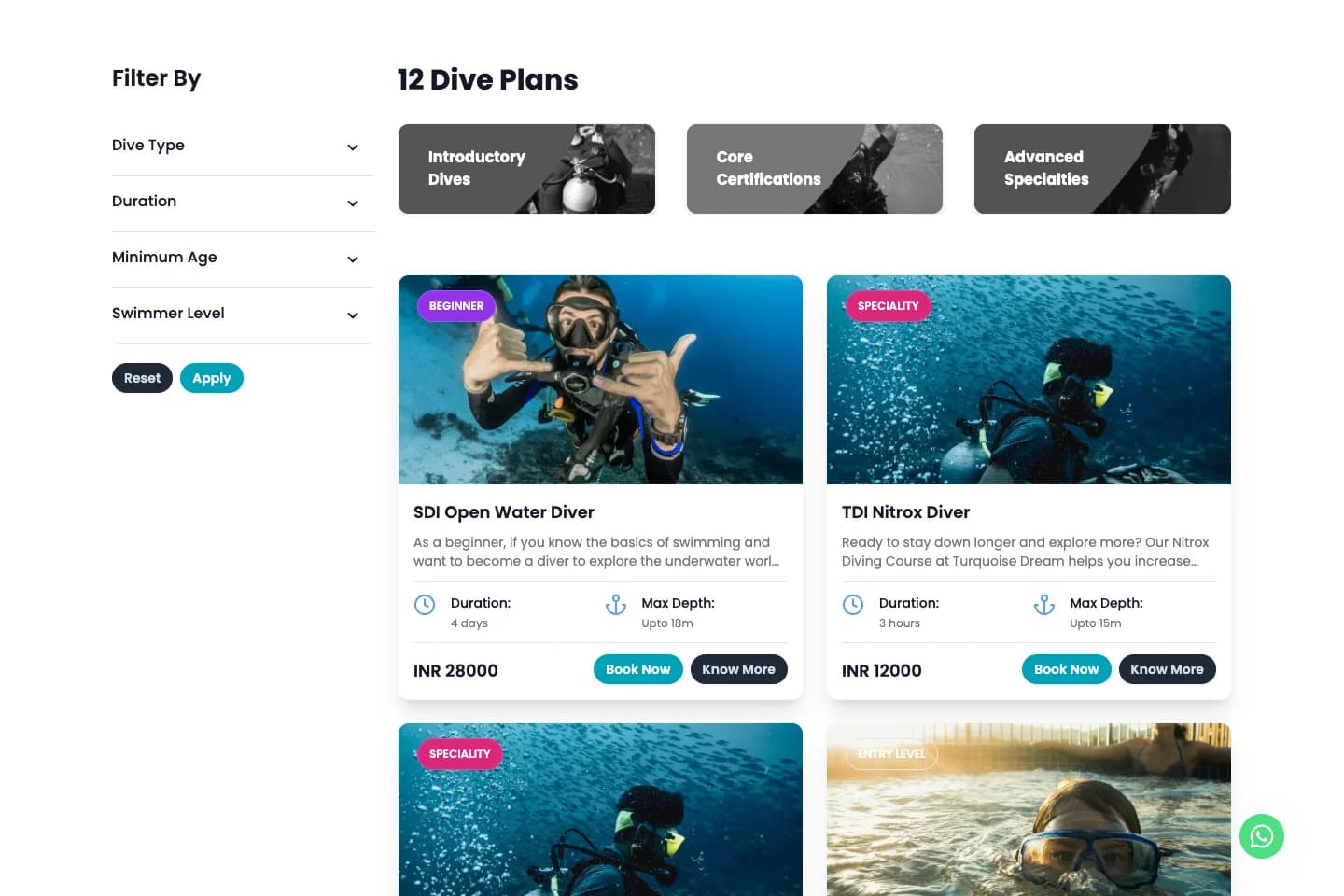
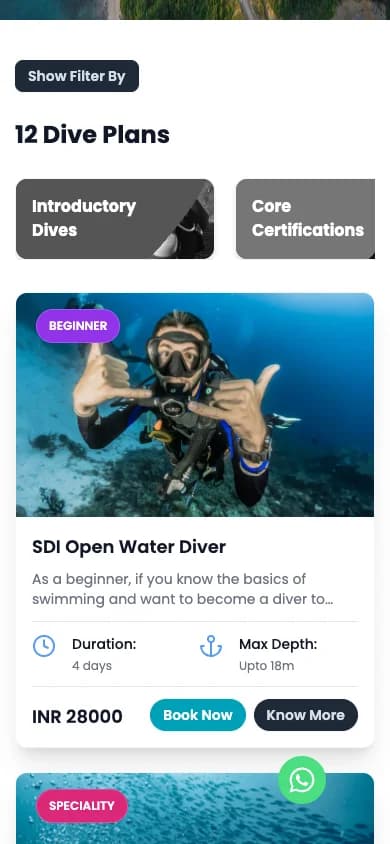
The public experience was designed around discovery and preparation: understanding programs, exploring dive sites, choosing dates, completing diver information, handling medical screening and making an advance payment.
Behind it, we built a mobile-first operational experience around what the team needed to know: who's coming, what they're doing, whether each diver has completed the required steps, what has been paid and what remains due.
WhatsApp could remain the conversation layer. The platform would become the operational layer underneath it.
The public website was designed as more than a booking page.
Dive programs, dive sites, marine life and editorial content give prospective divers the context they need before choosing an experience.
That also gives Turquoise Dream a structured public presence around the subjects people are already searching for when planning a dive trip to Neil Island.
Instead of discovery ending with:
"Message us for details."
the website can carry the customer from research into an actual booking journey.
The medical questionnaire was treated as part of the safety workflow rather than administrative paperwork.
Each diver completes their own screening as part of registration. The questionnaire follows the established recreational diver medical screening structure, including conditional follow-up questions.
Where an answer requires medical evaluation, the workflow can move into physician clearance rather than allowing the issue to surface for the first time at the dive centre.
A diver can share a dedicated review link with their physician. The physician can review the relevant information, provide an approval or rejection and sign electronically, with the outcome returned to the diver.
Why it matters
For a customer travelling to an island to dive, discovering a medical clearance requirement before travelling is materially different from discovering it on dive morning.
One booking can represent several people, but medical readiness belongs to the individual.
The system therefore separates the commercial booking from each participant's preparation.
The lead customer can choose the experience and dates, while each diver completes their own details and medical screening.
That turns a group booking from one record with paperwork attached into a clearer view of who is actually ready to participate.
The checkout was designed so pricing does not depend on values supplied by the customer's browser.
The system retrieves the plan price and calculates the relevant booking amount, GST, advance and applicable fees before the payment order is created.
Payment confirmation then becomes part of the booking record rather than another transaction the team has to reconcile manually.
The same principle continues inside the operational system: pricing and completed payments determine what remains due.
The internal system was designed for the reality that staff may be working from a phone rather than sitting behind a reception desk.
Instead of manually copying every field from a customer conversation, the operator can paste the WhatsApp enquiry into the system.
The relevant customer, contact, party, plan and date information can then be turned into a structured booking.
From there, the team can share the customer's registration link back through WhatsApp.
Conversation → Booking → Diver registration → Medical readiness → Payment → Dive schedule
The workflow becomes connected without asking customers to abandon the communication channel they already use.
A booking being confirmed doesn't necessarily mean every diver is ready.
The operational view brings the important pieces together so the team can see the booking, participants, schedule, payment position and completion status without reconstructing the situation from messages and paperwork.
The weekly schedule surfaces diver readiness alongside the operational information the team needs for upcoming dives.
Instead of discovering missing information when customers arrive, staff have a way to identify it earlier.
The internal experience was built mobile-first because that's where the work actually happens.
Plans can have variants. Bookings can contain multiple divers. Payments can happen in stages. Staff need week and month views of what's coming up. Customer records need to remain searchable even as the database grows.
These weren't treated as separate admin features.
They were designed as parts of the same operational workflow — giving the team one place to move from an incoming enquiry to the information they need on dive day.
WhatsApp wasn't replaced simply because a new system existed. The product was designed around it as the business's existing enquiry and communication channel.
Medical screening and required participant steps belong to each diver, rather than being hidden behind a single booking-level status.
The internal experience was built around staff working from phones, including an installable app-like experience.
Programs, dive sites, marine life and editorial content form part of the public experience rather than existing as disconnected marketing pages.
Bookings, diver readiness, schedules and payments are brought together instead of being reconstructed from separate conversations and records.
Before
Customer discovery, WhatsApp enquiries, paper medical forms, payments and operational coordination existed as separate parts of the business.
Medical issues could surface late, and staff had to piece together booking readiness from conversations and paperwork.
After
Turquoise Dream now has a connected system spanning the public customer journey and the operation behind it.
Discovery → Booking → Individual diver registration → Medical screening → Physician clearance when required → Payment → Operational readiness
Customers can prepare before arriving on Neil Island, while the team has a structured view of the information needed to run upcoming dives.
The platform is live and operating in production. Quantitative impact metrics have not yet been added to this case study, so no booking-volume, conversion, time-saved or revenue claims are being made here.
Turquoise Dream demonstrates what happens when the website isn't treated as the entire product.
The customer-facing experience mattered, but the bigger opportunity was connecting what happened before a booking, during registration and behind the scenes once the booking reached the dive centre.
Rather than forcing the business into a generic workflow, we kept the behaviours that already worked — particularly WhatsApp — and built the missing software around them.
The result is not simply a dive-centre website. It is a digital layer around how the business finds customers, prepares divers and runs its operation.
The answer isn't always replacing everything with another off-the-shelf platform.
Sometimes the better solution is connecting what already works and building the missing pieces around your actual workflow.
Discuss your project